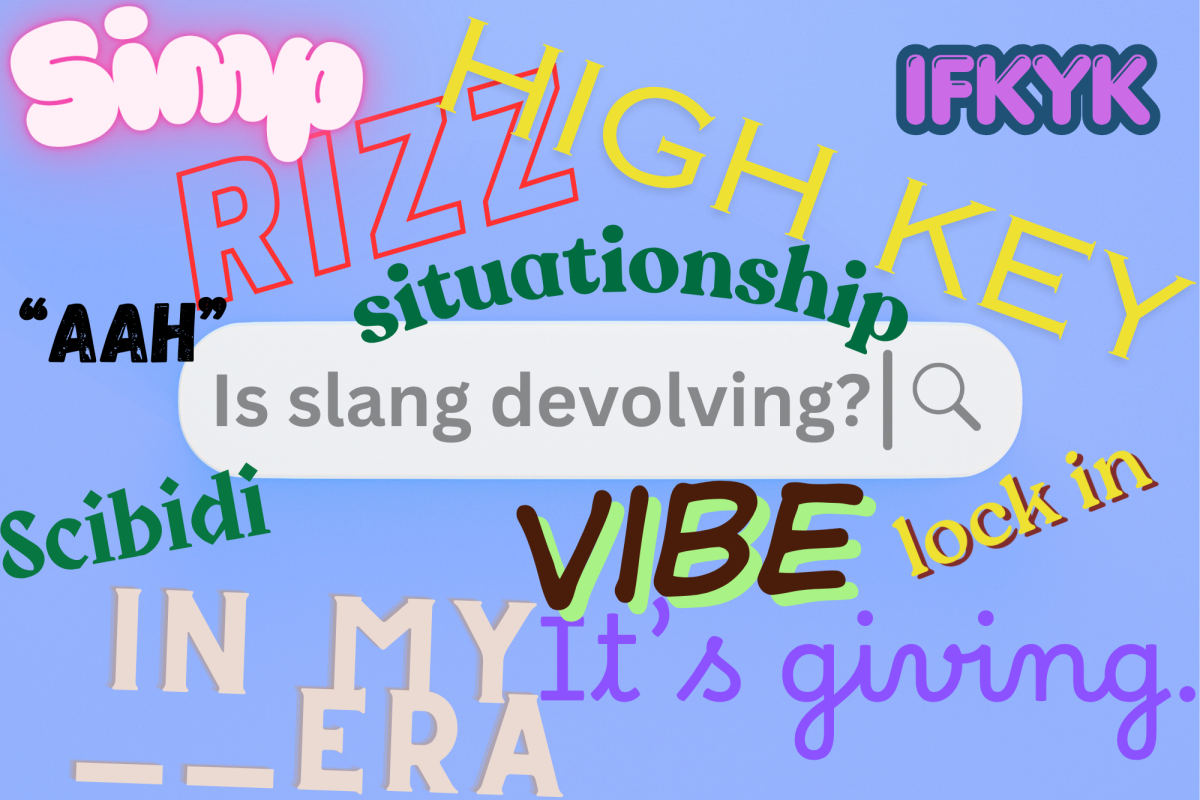
“Gyat” “Rizz” “Skibbiti” “yapping” “mogging/mewing.”
It feels like every day there is a new word online gaining traction, and it can be hard to keep up. By the time that you figure out what it means, a new word takes its place.
It’s diluting the English language!
Well, no. Slang is a natural part of the development of language, and as long as generations cycle around, things keep happening, and humanity can still communicate, there will always be slang.
In “How Language Works,” a book by David Crystal, he said, “The only languages that do not change are dead ones.”
But for most people, it isn’t the fact that language is changing, but rather the fact that it is so confusing, and the words “don’t make any sense.” But this is also wrong, because it does make sense if you know where it comes from.
Slang is an inside joke of sorts. If you know the slang, it signals you as someone with the “in-group,” while those who don’t know it are in the “out-group.” Additionally, as slang is often associated with the younger generations, not knowing what certain slang words mean or where they come from may signal that you are old or “unc.”
Merriam-Webster defines slang as “an informal nonstandard vocabulary composed typically of coinages, arbitrarily changed words, and extravagant, forced, or facetious figures of speech”, but linguistics has a difficult time determining what slang is.
Slang often originates from a small group of people. The new words or phrases mean something, and they are then taken to be used by a greater audience. At some point, the word may change to better fit the original intent.
For example, the word “woke” was originally meant to refer to those who “awoke” to the bad things happening around them, often politically. Eventually, it became an insult as a result of the negative connotations among right-leaning internet users. In centrist to left-leaning groups, however, they tend to use it ironically to make fun of the overuse of the word “woke.”
Because of the fast-paced nature of the internet, new in-groups can form very quickly, and people can make a lot of jokes using those concepts. But for those on the outside, it can be very annoying to always have to catch up on new slang and jokes.
But despite the amount of seemingly stupid slang that will surely die off, slang is also important as it shows change. While this isn’t slang, the trend of people using more old-timey words in memes and in conversation shows the want for whimsy and the simplicity of the “good olde days” as people wish for stability, both economically and politically.
It is very normal that we will get slang based on something no one will care about, but there are also words that are originally coined as slang that are still used today. For example, even though the word “selfie” is fairly new (coming from Australia in 2002), it is no longer considered slang now, and it is just a verb or noun, depending on context.
In the same vein, many dictionaries might add slang to their words of the year, or add them to the dictionary. Many people are not fans of this practice, with people saying that it feels off. At the center of this problem is the debate between what the purpose of a dictionary is. Some believe that it should be used to set the rules of the language, while others believe that it should be used to document all words that are used at a given time. Average people are more likely to believe the former. It is my speculation that this is due to the people, especially teachers, treating the dictionary as law, leading to this perception. However for linguistics and history purposes, the later is preferred, as it allows for people to have an exact idea of what people were saying. There is a lot of debate on this, but many dictionaries have been moving more descriptive.
There is speculation that the slang term “situationship” may turn into one of those words that will lose its slang connotation, as it would be a more interesting word than a casual or unofficial relationship, only being allowed due to the situation. This is just pure opinion, I just think it is a good word. It is very similar in my mind to “shipping” characters in media.
Merriam-Webster defines slang as “an informal nonstandard vocabulary composed typically of coinages, arbitrarily changed words, and extravagant, forced, or facetious figures of speech”, but linguistics has a difficult time determining what slang is.
What I can tell you is what people are going to define as slang. Plainly, most slang is made by people who aren’t rich white men.
I say most because some words are made by the young and wealthy, such as one of the most popular theories for the term “O.K.,” claiming that it came from a fad in the summer of 1838 in Boston by people on telegraphs, meant to be an abbreviation of “all correct.” It gained traction as democratic nominee Martin Van Buren campaigned for reelection with the phrase “Vote for OK,” standing for “Old Kinderhook,” which was believed to be easier to remember than Van Buren. This furthers the trend of technology shaping language, like how “idk” became commonly used. However, as language is constantly evolving, Gen Z more commonly uses it to soften the tone in texts.
To talk about slang, you have to talk about how it is changing the correct version of language. The problem being there isn’t one. The reason why certain things are considered correct is that the people who were making the rules on how a language is supposed to look or work were people who weren’t in this “in-group.”
Assistant Professor Lisa Morgan Johnson (Sociolinguistics, varieties of English) at BYU says in “IYKYK: Unraveling the Secrets of Slang” that before slang becomes common language, people consider it incorrect English.
“They say something like ‘I hope you teach them to talk correctly.’ . . . I try to explain to them that, first of all, linguists don’t believe in correct and incorrect language. We’re very interested in what people do with language,” Johnson said in an interview for the article.
Linguistics is not about telling people what to do with language; they are kind of like bird watchers with binoculars, except they are birds as well, staring at other birds to observe how they talk.