
It’s a sunny afternoon. Maybe you’re sprawled on the grass or doomscrolling on the couch, but in any case, you’re tearing open a sleeve of Ritz crackers (owned by Mondelez International under the Nabisco brand). You then proceed to wash them down with a bottle of Minute Maid juice (owned by Coca-Cola), and to finish it off, a bag of Lays chips (owned by PepsiCo). Different brands, yet the same handful of owners that dominate every sector of the market.
No matter what you go for, Oreos, yogurt, or cereal, it is nearly impossible to escape.
And that’s the lie we’re fed.
Every.
Single.
Day.
And it’s also the lie that continues to corrupt. According to a World Health Organization report released in 2022, obesity rates have tripled globally. Kids are now being exposed to harmful diets at a very young age, and foods we think are healthy are slowly killing us without our awareness.
But this drift into dysfunction wasn’t by accident. Starting from the 20th century, corporations began to realize how easy it was to manipulate the general public, and in doing so discovered the way to achieve the money-making dream they so desperately desired.
This turning point to scale, shelf-life, and money that beat out nutrition, however, didn’t happen overnight; rather, over a series of three main events that brought us to the main issues of today.
1971. President Richard Nixon faced rising food prices and political pressure, leading to key changes to the Department of Agriculture and a “get big or get out” mentality for farmers. Crop limits ceased to exist, and an influx of corn, soy, and wheat, the backbone of modern ultra-processed food, entered the mainstream American diet.
1977. The US released its first set of dietary goals through the United States Senate Select Committee on Nutrition, led by George McGovern. This initiative urged Americans to reduce cholesterol, eat more carbohydrates, and reduce fat.
Food companies, however, heard something different: Replace fat with cheap sugar and starch. Fat, which was once a normal part of diets, had now become public enemy number one.
1980s. By then, corporations were no longer selling food, but rather engineered pleasure. Chemists, psychologists, and behavioral scientists were hired to optimize the bliss point (perfect sugar-salt balance), maximize repeat consumption, and increase shelf life (this is when preservatives entered the picture). Food now became faster to eat, easier to overconsume, and less filling, leading to the rise of the modern fast-food industry.
And in the modern day, nutrition is just a marketing costume. Especially considering that in the US, from the 1970s till now, obesity rates went from 13.4% in adults to 40.3% in 2023, according to the National Library of Medicine. Globally, over 1 billion people are now classified as obese (BMI ≥30), and the percentage of children affected has quadrupled, going from 4% to 21% in under the span of only 40 years, as stated on the World Obesity Federation’s website.
And whether we realize it or not, everyone pays the price. It’s showing up in higher healthcare premiums, in classrooms where kids struggle to focus, and in communities where fresh food is scarce but ultra-processed foods remain largely available.
But what makes this dangerous isn’t just the food itself, but the fact that it’s an invisible danger. The same companies that are a part of the problem are the ones branding themselves as the solution. They are the transmitters, meanwhile acting like the doctor of their own act.
Bright packaging and labels of whole grain, plant-based, FDA-approved, and low-fat are simply false promises when one looks at the 5000-word-long ingredient list of a ‘food’ product.
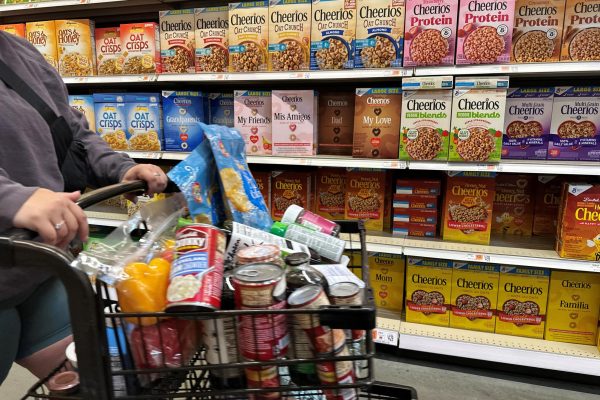
From refined sugars, to industrial oils, artificial flavors, trans fats, and chemical preservatives, our bodies are being hijacked into consuming things made by multi-step machines in the same place an industrial factory could make non-edible goods.
Take corn–once a whole food, now a raw material, it’s in almost everything we eat. But not for nourishment or taste, but yield. And there are acres of it, all identical and sprayed with pesticides and subsidies, then harvested by machines, broken down by mills, stripped of its fiber. Its starches then dissolve, and all that remains is sweet syrup that no longer resembles food at all; clear, cheap, and infinitely useful. That ingredient is high-fructose corn syrup. It doesn’t spoil, nor does it fill you; it just keeps you going back into the bag for more. And that’s the intention.
Humans were not meant to consume high-fructose corn syrup. . All of these ingredients are inflammatory on the molecular level and part of the leading cause for an increase in heart disease, cancer, and type 2 diabetes.
This isn’t just about personal failure and lack of discipline, even though that is arguably becoming a more notable problem in society today. It’s simply because the lifestyle we were taught quietly, becoming ordinary, affordable, and unavoidable, is not normal.
Corruption here doesn’t look like laundered money, but rather the cost of our health. It’s the policy meetings, regulatory loopholes, and the nutrition panels paid for by the very same corporations they’re meant to regulate.
Take corporations such as Kraft Heinz, known for a multitude of products consisting of Kraft Mac and Cheese and ketchup. They don’t just sell food–they are a corporate PAC dealing with lobbying power. PACs like this also fund the very political action committees that we, the people absorb the cost of, with the system regulating itself. The market is simply one big monopoly consisting of smaller ones, with the appearance of competition consolidating control for the few that dominate the shelves.
It’s a system so well designed that it’s now embedded into daily life, and we don’t even question it.
To be fed the lie is to be told this is normal–our bodies can handle it. However, it wasn’t always this way, and it doesn’t need to continue. We need to start with transparency labeling, limits on deceptive marketing, and a renewed focus on real nutrition, rather than considering ketchup a vegetable.
This goes beyond the food. We consume the decisions we create, thinking we can always fix ourselves later.
Later has arrived.