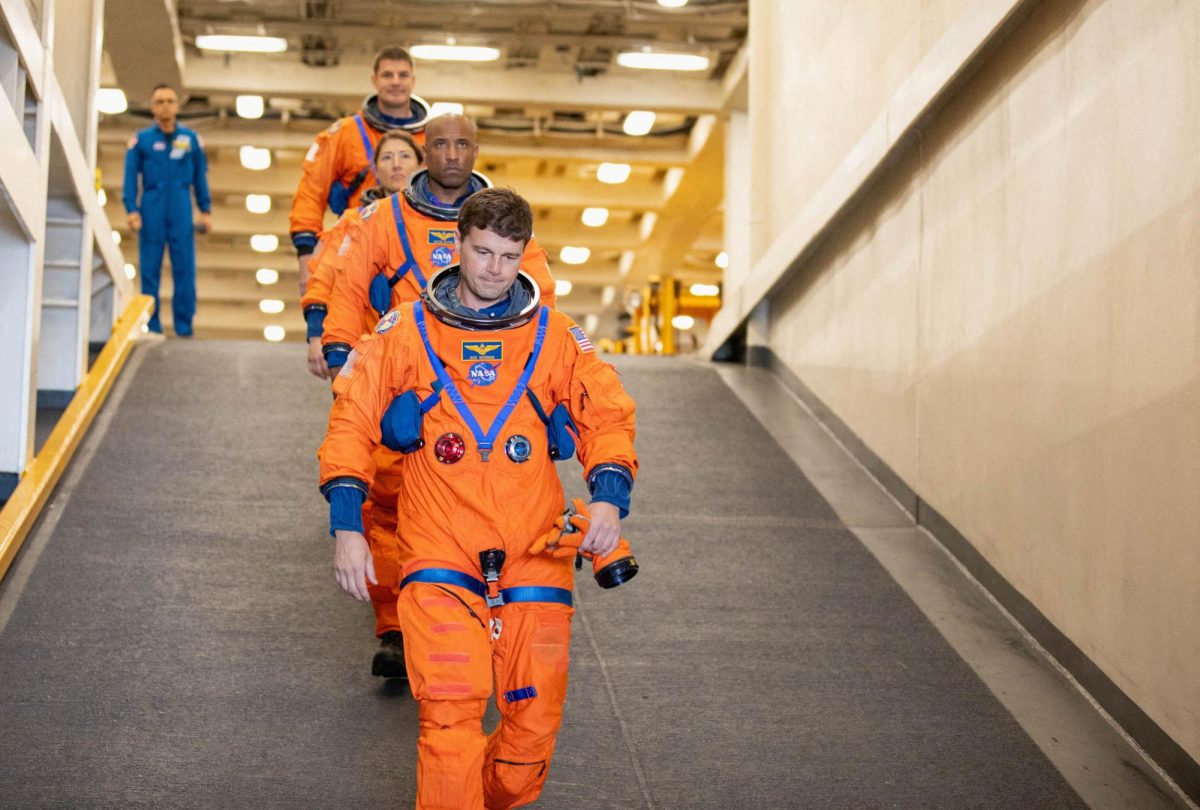
Following in the footsteps of the Apollo Program, the first crewed moon mission in over 50 years is set to launch from the Kennedy Space Center in Florida in the coming weeks.
On April 3, 2023, the National Aeronautics and Space Administration, NASA, announced the four astronauts planned to pilot the Artemis II rocket for the first crewed moon mission in over five decades.
The Artemis campaign is a four-part mission with the final objective of settling humans on the Moon. Artemis I, which launched in November 2022, tested the rocket and spacecraft to be used for the crewed space flight for Artemis II.
The crew, consisting of NASA astronauts Reid Wiseman, Victor Glover, Christina Koch, and Canadian Space Agency (CSA) astronaut Jeremy Hansen, entered quarantine Jan. 23, 2026, two weeks prior to the initial launch that was planned for Feb. 8, to ensure their health and limit exposure to illnesses before the launch.
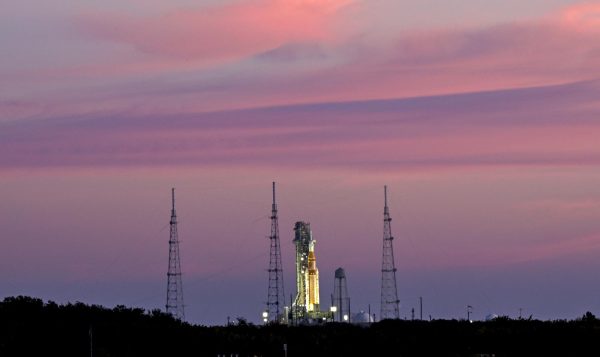
The Orion spacecraft, the Artemis II launch vehicle, is planned to take flight from Florida in either early March or early April. Though originally slated to launch in early February, cold weather and complications delayed the mission following the wet dress rehearsal on Feb. 2, 2026.
The flight itself will be a ten-day mission in the Orion spacecraft, which will orbit around the Moon at 5,000 miles from the surface, allowing the astronauts to view the north and south poles.
This new perspective will grant scientists a unique outlook of the Moon’s surface and further their understanding of possible habitable conditions that could sustain human life in the near future.
“Artemis II science operations will lay the foundation for safe and efficient human exploration of the Moon and Mars,” according to NASA’s mission page.
The increased distance of the spacecraft from the Moon’s surface, in contrast to previous missions, also assists in further research of previous evidence of water on the Moon’s surface.
“Seeing water on other planets is gonna pique our curiosity even more and give us more advantages for future scientists,” junior Mikhaela Bismark said.
Additionally, the Artemis II mission will test crucial technologies to observe the effects of space on the physical and mental health of the Artemis crew. Newly developed tools like ARCHeR and AVATAR will be used to monitor human vitals in deep space. These technologies will be essential for future settlement on the Moon in the upcoming Artemis IV mission.
“We’re spending a lot of money to advance technology for a lot of different uses,” Ms. Brown, Science Department Chair and teacher, said. “Sometimes research has already been done to develop a technology…that NASA can use or [people on Earth can].”
NASA intends to build upon the Artemis II launch with Artemis III, which aims to land humans on the Moon’s south pole by 2028, and Artemis IV, where the primary objective will be to construct a space station on the Moon.